Merlin Streamliner
The Vehicle
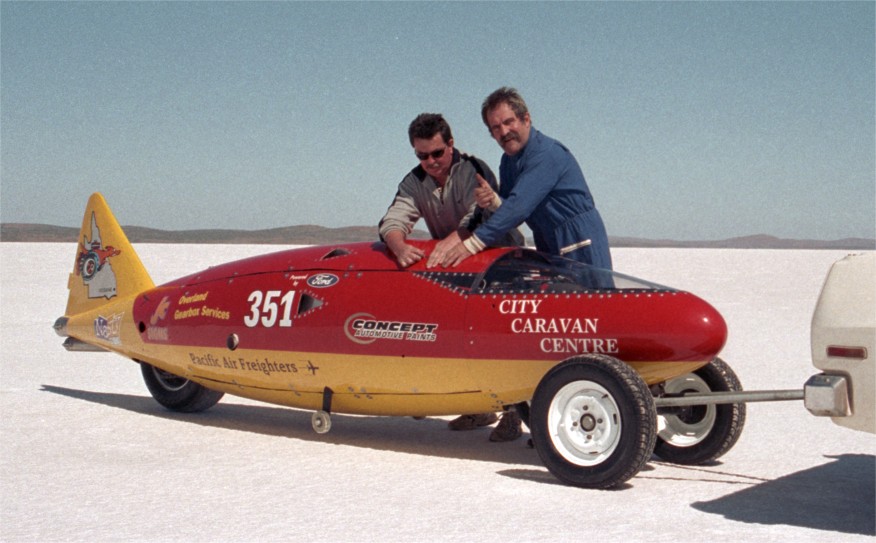
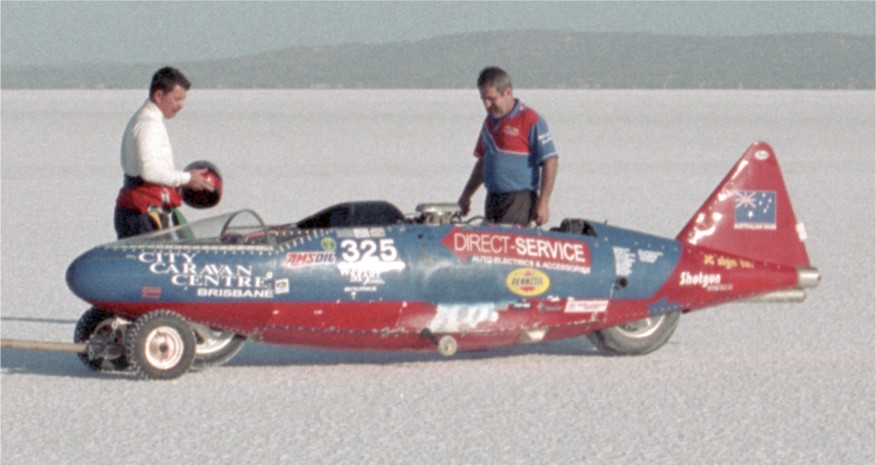
Team Merlin driver and owner ready for the return tow to the pits at Lake Gairdner, South Australia, March 2002 with a new towing dolly and fresh paint job.
 |
Lucky Keizer
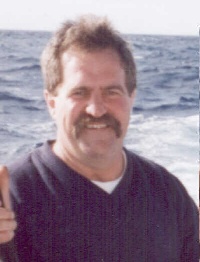 |
The man with a dream - design it, build it, do it, and all in the most innovative way. |
Ever since Lucky can remember, he has had a fascination with engines. Of course, an engine is only the starting point. You then have to do something useful with it - what better thing than to go faster than the competition.
As an 11 year old he started on the right track by fitting a motorcycle engine to a baby's pram, complete with steering and brakes. The local constabulary were less than impressed when Lucky tried it out on the street though!
Since then, and amongst other things, Lucky has built a gyrocopter plus of course, the now famous Merlin 5 litre V-twin. His engineering skills are much sought after within the local motorcycle fraternity, with his custom frames a specialty. He has an uncanny feel for engineering, and does not need fancy computers to know if a concept will work or not - his years of field experience stand him in good stead.
Needing an outlet for his talent and enthusiasm, he initially applied himself to the drag racing scene. After a while this area seemed less then ideal, so he changed focus to setting Land Speed Records. That is where we are today.
The Aim
The vehicle initially ran the Unlimited Gasoline Motorcycle Streamliner class, but currently is Streamliner Gasoline. Lucky intended to firstly obtain an Australian Record for the class, and then see it he can give the World Record a bit of a nudge.
The World Record for the class is presently held by Jim Feuling from the USA at around 332 mph.
The Current Driver
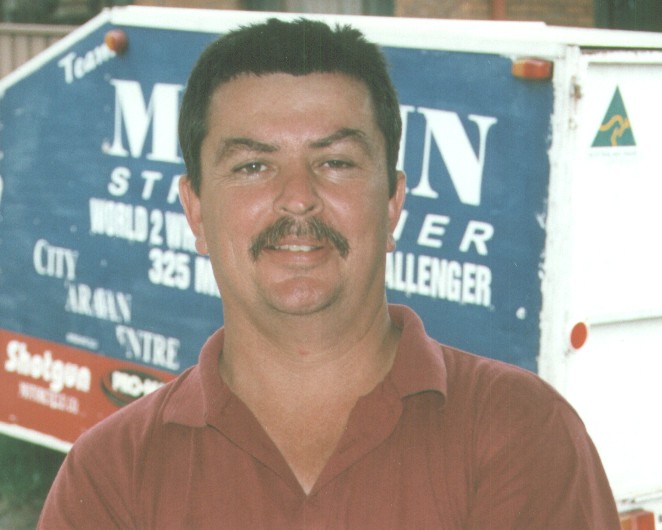 |
Linden Cooper. Linden joined the Team in
late 1998, and was full of enthusiasm for both the 2000 and 2002 record
attempts. He is a current hill climb competitor, as well as a bike
rider, and therefore has a suitably broad experience to handle the
Merlin. |
Merlin History
The creation of the engine in 1985 and its first use in a drag bike took some 2000 hours hard work. Found lying around an Australian outback farm, the original 1938 Rolls Royce Merlin V12 model 25 engine was beginning to deteriorate. Lucky made a clever purchase, and carefully dismantled the engine to figure out how best to use it. The quality of it's engineering impressed him greatly, and he strove to maintain this in its new guise. Two cylinders seemed enough capacity for mortal man, so Lucky sliced off a pair and started work.
As two pistons are inherently unbalanced in comparison to the original twelve, a great deal of thought went into the 300 hours that Lucky spent designing and fabricating a suitably balanced crankshaft. Until it is seen running, most observers expect the engine to jump around and shake itself to death. The results of his work are impressive, and the observers become open mouthed when they find how smoothly it runs. It does have its vibration periods, but they are not troublesome.
When first
installed in a street bike type frame, it turned into
this:-
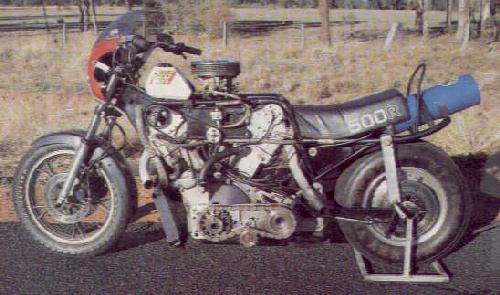 |
Unlike most drag bikes, this one could actually be ridden around the street. A bit impractical for commuting, and perhaps too unconventional for road registration anyway, the bike and its engine have since been displayed in a number of places around the world.
The concept of a land speed record vehicle based around the engine appealed to Lucky. The size of the engine dictated the overall width of the vehicle, and fortune smiled upon him (perhaps he was lucky) when he discovered that a discarded drop tank from a Neptune bomber was just the right size. Aerodynamically, it also fitted the bill, as its shape in the air is quite a slippery one. A number of salt lake racers have successfully used similar belly tanks from aircraft in the past.
Once the engine and the shape were finalised, the rest just fell into place - all that was needed then was more time and effort - nothing unusual for a person with Lucky's determination.
In its Merlin form, the engine was
shoehorned into a circular frame to accommodate the form of the Neptune
bomber drop tank. Unclothed, it looks like this:-
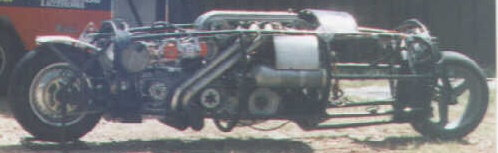 |
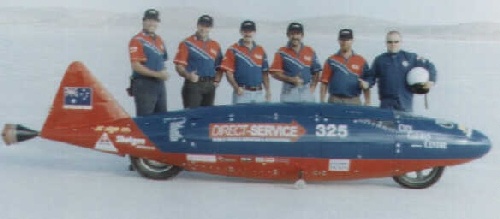
Initially the vehicle only made a few preliminary runs as part of a testing program. A major difficulty was the availability of suitable venues. Some running was done at a local Air Force base plus a 1996 trip to the salt flats of Lake Gairdner in South Australia. From Brisbane it is a two day plus drive, so is not undertaken lightly! At the lake a few teething troubles were ironed out, but the weather provided the conclusion to that meeting of the Dry Lake Racers of Australia through excessive winds.
Team Merlin with the subject vehicle on the salt at Lake Gairdner, South Australia, March 1996
|
In 1997 the lake was under water at the same time of year, an unseasonable thing to happen. Hope was then pinned on the 1998 meeting in early March, to try out its legs. The results of this attempt are described under 1998 results below. Further attempt have been made in 1999, 2000 and 2002. The varied results are shown below.
Team Merlin driver and owner ready for the return tow to the pits at Lake Gairdner, South Australia, March 2000
|
|
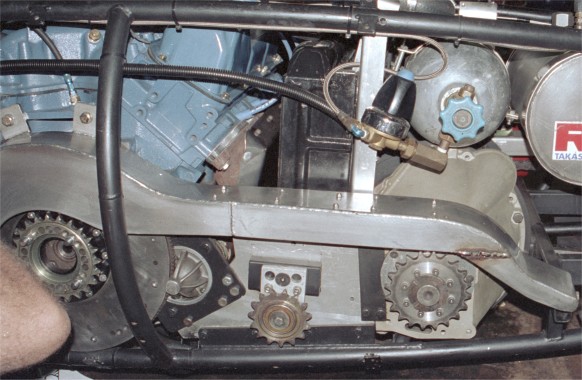
The current Ford 351 cu. in. V8 does
fit in the frame, as shown below :-
 |
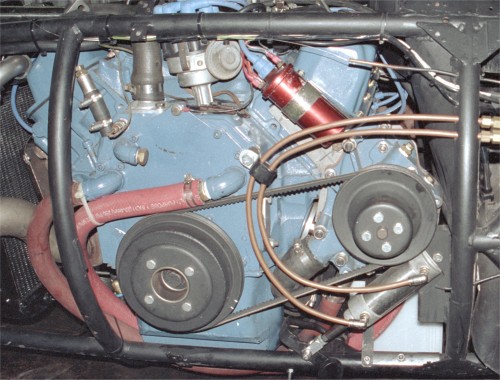 |
Specifications
The vehicle is undergoing continuous revision in a number of areas, so the following details may be out of date by the time you see this:-
| Engine | Original engine was Merlin based V-twin of
5 litre capacity. Rootes type supercharger running pump fuel. Has
optional fuel capability to suit application. Dry sump with twin oil
pumps. Second engine was standard 302 cu. in. Ford V8 unsupercharged. Third engine is modified 351 cu. in. 4V Ford V8 unsupercharged. |
| Clutch/Gearbox | Strengthened Holden clutch, driving through cross-shaft. Original used two speed gearbox, second version direct gearbox drive. |
| Starter | Original engine uses
external Douglas DC-3 electric starter used with
direct drive to crankshaft, although tow starting
is performed under operating conditions to
minimise the loading on the clutch and
transmission. Current engine uses conventional electric start from onboard battery.. |
| Final Drive | Chain drive from cross-shaft. |
| Frame | Arc and gas welded tubular frame chassis using normal steel tubing. Incorporates rollover protection and strengthened drivers compartment. |
| Body | Removable fibreglass body panels. Shape conforming to Neptune bomber drop tank. |
| Brakes | Rear disc only, but parachute(s) required and used for high speed runs. |
| Wheels | Rear - 15 inch Centreline. Front - Suzuki GSX 17 inch. |
| Tyres | Rear - Bonneville. Front - Michelin Road Race. |
| Suspension | Rear - unsprung. Front - leading link. |
| Race weight | About 600 kg ( 1300 lb) |
Team Merlin 1996
A team of dedicated helpers and supporters have assisted Lucky over a number of years. The 1996 group shown in the photo taken at Lake Gairdner, from left to right, together with the area of assistance they provided, are as follows:-
| Frank Ragonese | mechanic |
| Rod Tyson | electrician, mechanic, promoter |
| Dave (Bones) Skelton | sponsor, assistant |
| Lucky Keizer | designer, builder, owner |
| Pat Moran | bodywork, assistant |
| Free Wilson | driver, assistant |
Team Merlin 1998
The 1998 team was as follows:-
| Rod Tyson | electrician, mechanic, promoter |
| Lucky Keizer | designer, builder, owner |
| Rob Preston | assistant |
| Joseph Hodzic | driver |
| Sylvain Minier | driver |
Team Merlin 1999
This year's team were as follows:-
| Lucky Keizer | designer, builder, owner |
| Linden Cooper | driver |
| Rob Preston , Ian Fettes | assistants |
Team Merlin 2000
This year's team were as follows:-
| Lucky Keizer | designer, builder, owner |
| Linden Cooper | driver |
| Ian Fettes | assistant |
Team Merlin 2002
This year's team were as follows:-
| Lucky Keizer | designer, builder, owner, driver |
| Linden Cooper | driver |
| Dave Hall | crew chief |
| Ian Fettes, Stuart Carter and Rod Watson | assistants |
Results 1998
The March 1998 trip to Lake Gairdner produced some mixed results.
During the past year Lucky has quietly worked on the machine, overcoming a number of potential problems he foresaw with the front suspension following the 1996 trip. A number of engineering improvements have been incorporated, along with improved visibility for the driver.
At the last moment before the 1998 trip, the scheduled driver Free Wilson was unable to attend the meeting, requiring Lucky to chase around for other likely candidates. Driving a streamliner is no easy task, and apart from basic motorcycling skills, requires fast reflexes and sheer guts!
With literally only days to go, two potential drivers were found - Joseph Hodzic and Sylvain Minier. To their credit, they piloted the streamliner for a proving run each before the weather settled in at the Lake, putting an end to the proceedings.
Overall the results were very encouraging, proving the stability and reliability of the Merlin. The actual speeds achieved were quite slow by record standards, but the vehicle greatly impressed the onlookers with the effortless manner in which it ran. The new front suspension performed very well, contributing to the overall stability.
The team are all looking forward to 1999, where less wind and more success will be most welcome.
The 1999 Event
The 1999 event has now been run, with further encouraging results. A number of improvements and major safety innovations were incorporated into the drivers compartment this year.
A total of only three runs were made, with the new driver Linden Cooper establishing most of his licencing requirements. He is now qualified at the 150 mph level. All the runs were plagued with what appears to have been electrical troubles that disrupted the fuel flow. This caused backfiring from the resulting lean mixture - a situation that is hardly desirable in a supercharged engine. A peak speed of around 160 mph was very easily achieved before the engine was shut down.
The Merlin again proved very stable as the speed built up. The last day at the lake was spoilt by overnight rain, as it left surface moisture that did not dry out quickly enough for a further safe run to be made.
The overall performance has given the team real confidence, and the year 2000 event is looked forward to with great anticipation.
The 2000 Event
This year was notable for a change in running class, brought about by the need for a substitute engine. Last year's problems with the Merlin engine required more repair time than was available due to internal damage. Accordingly, a Ford V8 of 5 litre capacity (302 cu. in.) was used instead, mounted sideways in the frame - yes - it does fit. This makes the new class SG-5000, being Streamliner Gasoline 5000 cc.
The old gearbox was replaced by a direct drive and clutch assembly, which worked very well, albeit with slow acceleration.
A total of only three runs again were made, with the driver Linden Cooper completing his licencing requirements. The best recorded time was 204.5 mph, putting the "Merlin" into the 200 mph Club. A pleasing achievement and we believe an Australian record for the class, though we know greater speeds were obtained beyond the timing points. The potential of the Merlin with this engine is around 250 mph, given a very long track.
Some problems with side winds were experienced, and our USA competitors in Tenacious II suffered similarly. In other respects the Merlin proved to be very stable, and it was only a drive belt breakage and the erratic crosswinds on the last two days that prevented a more prominent result.
The course was in excellent condition, and it's preparation and running a credit to the DLRA.
The 2002 Event
A year of mixed results. The engine was changed once again this year. Another Ford V8 of 5.7 litre capacity (351 cu. in.) with 4V heads was used, potentially giving more power at higher rpm. However, the single gear drive was retained and this proved to be a limitation with the reduced low rpm torque from the new engine.
As well as Linden, Lucky was also a driver this year. Lucky needed to complete his qualifying runs for his licence, so the first few runs for him were made at 125 and then 150 mph. He actually had three runs, but in the middle one was caught by a sudden crosswind gust that pushed him off course resulting in minor body damage to the streamliner when a set of timing lights could not be avoided. Crosswinds are the bane of motorcycle streamliners on the lake, as it pushes all of them off course.
Linden had more success in his three runs, though a spark plug lead burning out on the second run was discouraging. The third run provided a speed of 187.8 mph through the first timed mile, but Linden experienced unusual instability and shut the Merlin down early.
Both Lucky and Linden in fact had found a slow wobble developing over 150 mph causing the vehicle to weave across the course. This was quite disturbing and unexpected, as the streamliner had been very stable at higher speed in previous years. The conclusion reached on the cause of the problem was that blocking off engine air vents in the front wheel well had created a pressure buildup in that area. This pressure then lifted the front of the vehicle creating an unwanted steering effect.
Despite the increased engine power available, the high single gearing gave very leisurely acceleration, only reaching 180 mph in two miles. For next year a gearbox will be fitted to better use the available engine power in the earlier part of the course.
The course this year was again a credit to the DLRA, and the weather was kind to all.
2002 onwards
A review of the future of the present streamliner indicated that while it has been very useful as a test vehicle, there are a number of problems in achieving the ultimate goal with it. A smaller section streamliner is now being considered, and regrettably there will not be enough room to fit the ageing Merlin V-twin.
On the 1st July 2000 a syndicate was formed with Lucky and three friends. It's aim is to commercially develop and market the Merlin Streamliner to it's ultimate dream. This was to hold the Guinness Book of World Records World Land Speed Record for Motorcycles.
Syndicate members were:- Lucky Keizer, Linden Cooper, Ian Fettes and Ernie Williamson.
Despite enthusiastic promotion of the project by Ern Williamson, little interest ensued in marketing the development of a new vehicle. Sadly Ern's health finally caught up with him and he passed away in November 2013.
Since then Lucky has persevered with the new project, but no current details are available to show here.
Visitors You are
visitor |
| Revised on 9 January 2015 | Copyright © Ian D Fettes 1997-2015 |